
September 28, 2026
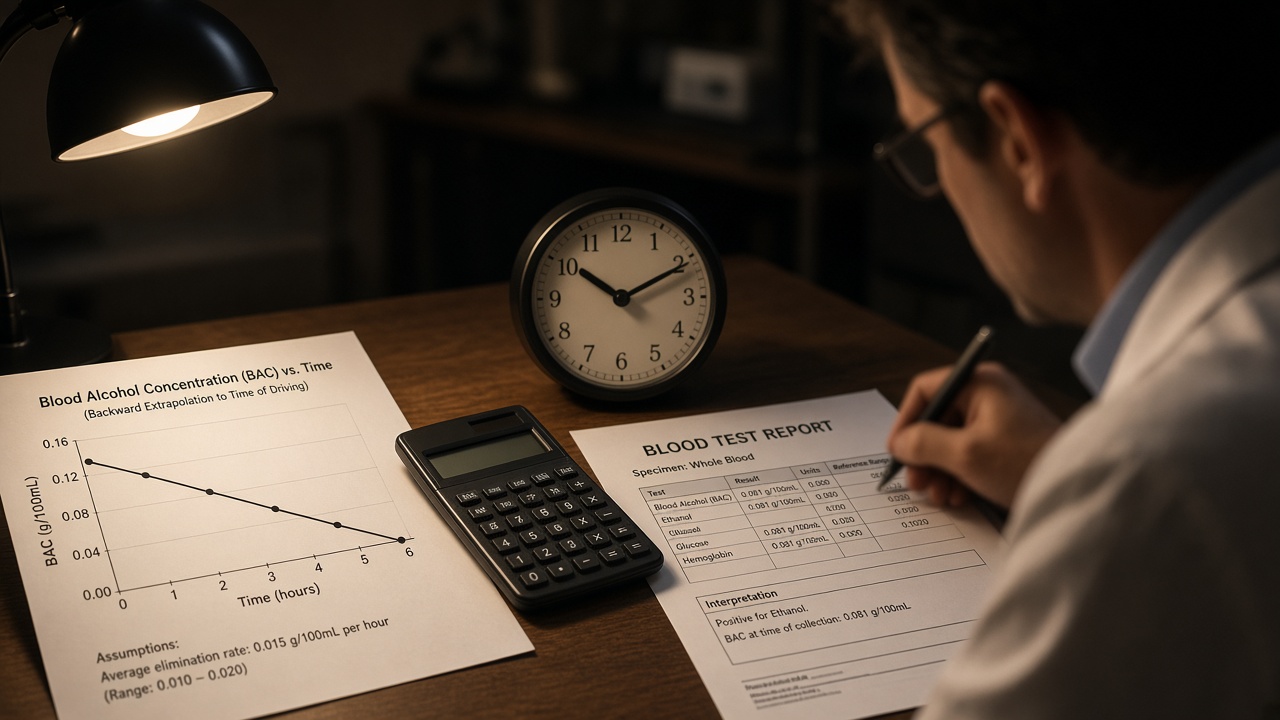
Working Backward From a Chemical Test
Sometimes a DUI case involves a question that cannot be answered simply by looking at the test result:
What was the person's alcohol concentration when they were driving?
A toxicologist may attempt to answer that question through a process commonly known as retrograde extrapolation.
What Is Retrograde Extrapolation?
In general terms, retrograde extrapolation attempts to work backward from a measured alcohol concentration to estimate an earlier concentration.
That requires assumptions about what happened between the two points in time.
The analysis may consider:
The measured alcohol concentration;
The time of testing;
The estimated time of driving;
Alcohol consumption;
The timing of consumption;
The absorption phase;
The elimination rate; and
Individual physiological characteristics.
The Critical Problem: Assumptions
The farther the analysis moves from the actual measurement, the more important the underlying assumptions can become.
If the toxicologist does not know when the person's last drink occurred, whether absorption was complete, or how much alcohol was consumed, those unknowns may affect the analysis.
Measurement Versus Reconstruction
This distinction is critical.
The laboratory may have directly measured a concentration in a sample.
The earlier concentration may instead be an estimate based upon scientific assumptions.
Those are not necessarily the same thing.
The Defense Analysis
A DUI defense lawyer should examine:
What was actually measured?
When was it measured?
What information was supplied to the toxicologist?
What assumptions were made?
Are those assumptions supported by evidence?
Could different assumptions produce a different result?
Florida DUI cases often turn on the difference between what the evidence shows and what an expert believes can reasonably be inferred from the evidence.
That distinction deserves careful attention.
Defend the Case.